Proposal 01
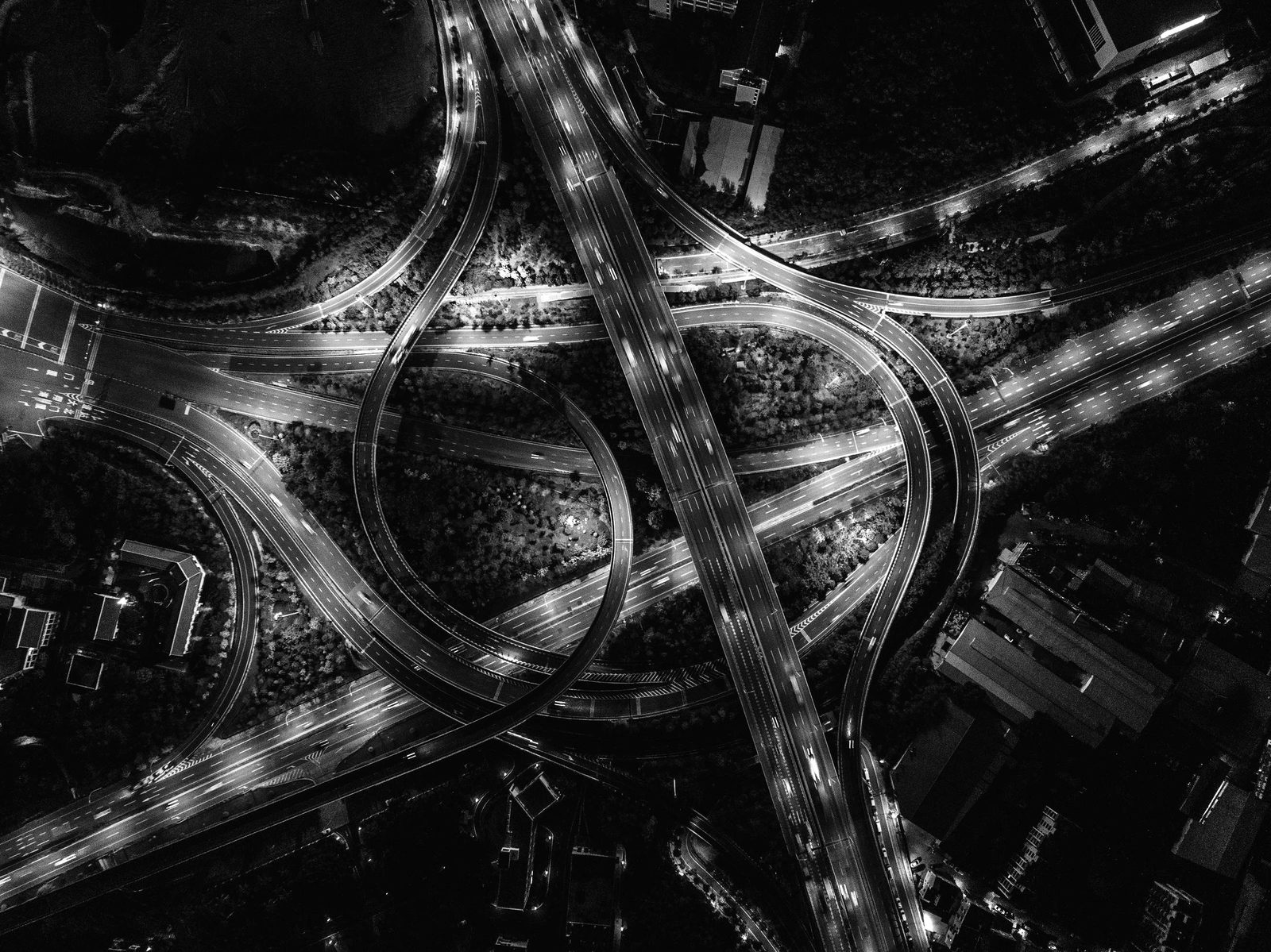
Grade-separated junctions
Underpasses and flyovers at the few junctions that decide the travel time of whole corridors.
The problem
In every urban network most of the lost time is concentrated in a handful of saturated nodes: at-grade junctions where the main flows cross and every signal cycle leaves a queue that never clears. Work on the road between two nodes achieves little; time is recovered at the node.
The intervention
Separate the dominant flows vertically: an underpass or flyover for the main movement, with secondary movements left at grade. These are expensive works with demanding construction, but they act on the real constraint of the network and free up surface space and signal time for every other user, public transport included.
- Where it works
- Corridors with a clear dominant flow, nodes with recurrent peak-hour queues, alignments where the structure does not cut through the urban fabric.
- What to measure
- Median and 95th-percentile travel time along the corridor, average queue length at the node, surface public-transport time on the same axis.
- Guiding rule
- Prior study: no increase in travel time and no overlap of flows. Verification afterwards with the Travel Time Index.
This describes a family of interventions: costs, feasibility and impacts must be assessed case by case with local surveys and a network model.